Showing posts with label soil. Show all posts

Monday, June 11, 2012

What's in a Name?


When I moved into Fred's place, sight-unseen, mind you, I was tickled and astounded to discover the back yard, which extends into a natural park area hosting Stephen's Creek. The place screamed, “Work with me! I have SO much potential for infinite beauty!” I felt I had moved into a place not unlike “The Secret Garden,” which I am 2/3rds into watching with my sweetheart, actually. We're watching the vintage (original?) English version and Aeython finds it to be incredibly dry, slow and predictable, but it's the principle of the thing. A classic worth revisiting in my own personal opinion.

Sproutling baby choys rising their wee, green heads from the mushroom  compost!

But back to the garden! The house is perched up near the top of the hill and out back, there are tiered garden beds of various sizes and lengths, created a bit haphazardly with some rocky chunks of broken up concrete. It's clear to me now that the previous owner's M.O. was based on economy, practicality and little to no maintenance required, whatsoever. As we begin to clear spaces for growing food, this becomes more and more readily apparent with our succession of discoveries. There have been a few pleasant surprises, however. Aeython has revealed many of these special finds, which include:
a “throne” seat made from some large, smooth concrete slabs, tucked into a nook on the lower-most tier, which faces out toward the rest of the garden and park, a set of small, gradual steps leading to a tier that was previously not very accessible by comfortable means, which had been shrouded in a flowering ground-cover, a bumblebee's nest tucked into the concrete chunks on a tier equally engulfed in ivy, as well as a garter snake's den in a similar fashion on an opposite tier.

A view of our house from below. Aeython chopped an invasive tree that  grew up beneath the shed.
Now that it's all exposed, I'm planning to make some Mason Bee houses using cut bamboo tubes and
mount them onto the beams below, offering them a nice sheltered spot. :D
                                                       
The name for this blog came to me while trying to rip out a nasty, black, plastic weed-block cloth, which has long since failed to serve its purpose. It was a typical, overcast and drizzly day in Portland and my attempts were centered around clearing an area to create the bee yard. Knowing that the weeds will only grow taller with every passing day, I couldn't very well just leave it as is, blocking the entrances to my future hives. As well, we're trying to utilize every possible space for growing food or bee forage and the weed-block absolutely, HAD TO GO!
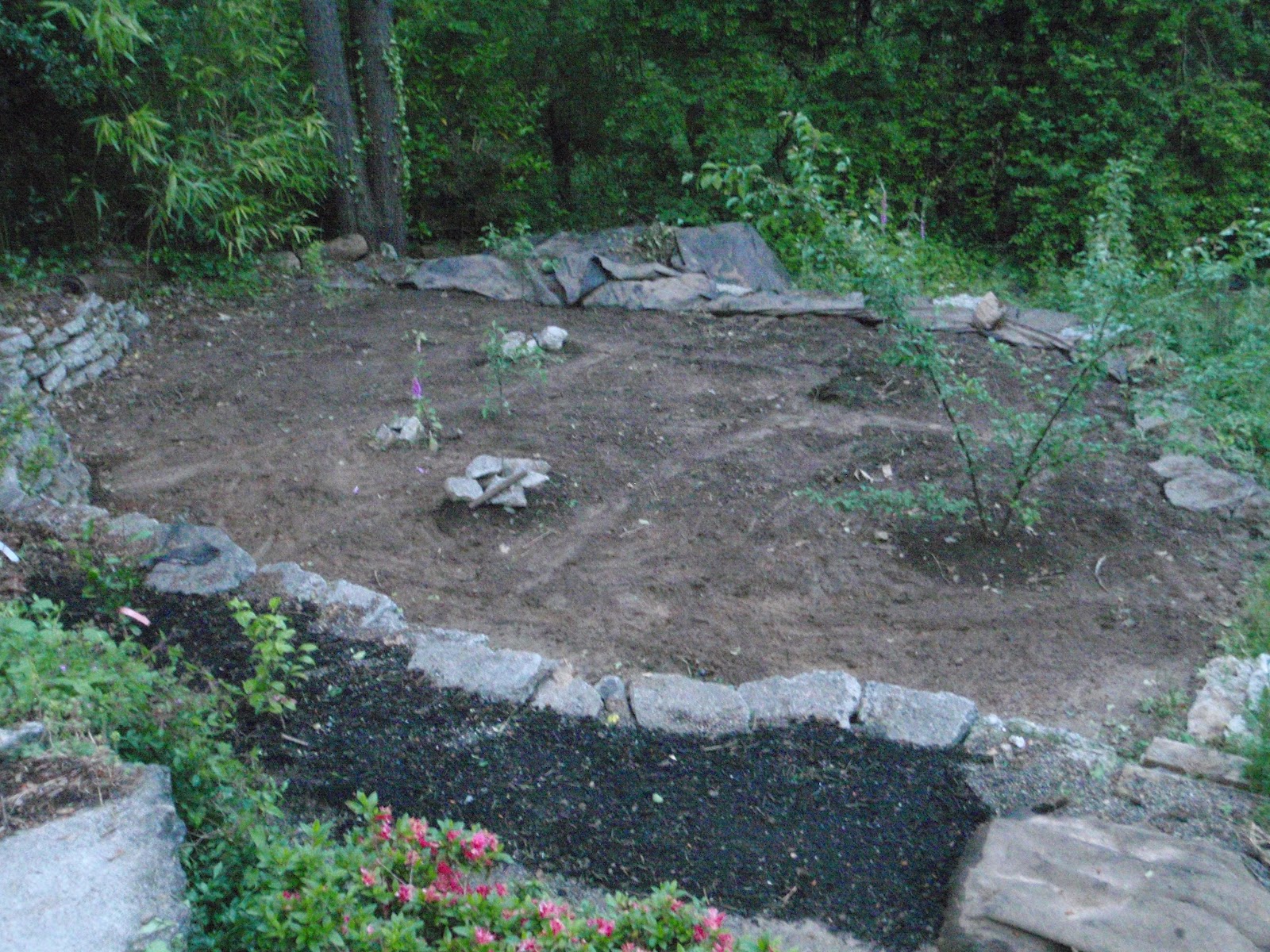
The cleared tier from above. The throne is situated just to the left of the bamboo in the corner.
The dark, mulched blueberry, tea and flower tier leads to the beehive against the Doug Fir.
This was no easy task, as plenty of soil had spilled into that lower-most tier, providing a growing medium for the abundance of weeds. Their root systems were developed, growing down and gripping onto the weed-block with ferocity. Worst of all, was that the previous owners had embedded the cloth beneath the concrete slab walls of the tiers. I employed scissors, I ripped, I tore, I pulled and pulled with all my might, hoping I wouldn't tear myself in the process and created a weed sod sculpture or abominable "weed man" by stacking the stuff higher and higher along one corner of the tier.

Beneath all this, was free and clear, very compacted, nutrient and moisture deficient soil. The only aeration being offered was by tunnels bored into it (somehow) by moles or shrews. But the dirt had finally been liberated! After Gawd only knows how many years!!! Success!

This process did not take me a day, however, it spanned the length of several days, with days in between to heal my general aches and overly worked hands. It was an annoying task, but one with near immediate gratification and immense eventual payoff. Aeython has helped clear other areas and suggested we use the weed-block to drape over our weed sod piles to cook it down into a rich compost.
Some of it is also covering areas of grass, which we hope to stamp out for more crops.

Repurposing the weed-block to kill itchy, weed-infested grass for more growing space.
We plan to utilize the large tree stump there for a mushroom cultivation project by drilling
holes into it and impregnating it with some spores in a sterilized substrate such as alfalfa straw.
I'm growing my own culinary oyster mushrooms now from a large ziplock baggie on a plate up on the balcony.
We've gotten two full fruitings from it since I took the class at People's Food Co-op in March,
adding a lovely taste and texture to our delicious sautées.

The next step for this large tier in question, was to till it somehow, so he had Fred help him with the use of a certain hand-held rototilling machine, powered by an unknown gas mixture, which apparently is very loud, difficult to use and probably only loosened up the top few inches of soil. But it's a start, nonetheless, and will help us incorporate nutrients back into the top layer, and allow us to plant some covercrops, namely Buckwheat, Barley and Fenugreek.

Since the task is going to be a process that takes time and care, and because I learned that bees prefer high locations for their hives, I went with placing the first hive on the next tier up. It is appropriately protected on at least 3 sides, by a large Doug Fir tree, the neighbors' fence and the next tier up, hosting a large yucca plant, one of 3 that we decided to leave in place at the far end of the tier, even though it isn't native. Fred built me a good, sturdy stand for the hive to be lifted at least a foot off the ground, another bee-requisite.

A pic of the large, tilled tier from below.
The little paths will be our walkways between garden beds.
I assembled the hive supers (boxes) and frames from purchased wood parts and painted the outside of it a beautiful sage green with an exterior latex paint. This entailed gluing the dove-tail joints on the corners of the boxes with a wood glue and hammering in galvanized, exterior-worthy nails. Fred helped me with drilling the pilot holes using his drill press. I think he enjoyed it and I was grateful for the help.

The frames were similarly glued and nailed with smaller nails and once dry and complete, I snapped in the foundation, a plastic sheet embossed with the hexagonal comb pattern and coated with a thin layer of beeswax, indicating to the bees, draw this comb out, please. The roof was a fun project as well, though already pre-constructed.

I went with an eved, copper roof, not only because it looks amazing and is a welcome addition to the garden, resembling a quaint, little house rather than a flat-topped box, but because in the Pacific Northwest, it rains, A LOT, and if there's one thing that bees have trouble regulating it's moisture within the hive. They have special tricks for cooling the hive if it gets too hot by fanning their wings rapidly at the entrance, facing in, butts high and drawing the warm air out. This process is also employed as a way of reducing the water-content in the honey to make it the perfect 17% water, allowing it to keep indefinitely and not ferment. This takes a great deal of work on their parts, so the higher, sloped roof adds more space at the top for air flow and ventilation.

Fred was understandably worried about copper being exposed to vagrants wandering through the park, who may get the hair-brained idea of lifting it for some quick cash. I also saw the problem this posed and did my best to reassure him that I would take precautionary measures to deter theft, whether it be signage indicating, “Bees at Work,” or heavy chains and locks all the way around the hive. Another threat of the roof lifting off the hive is posed by heavy winds, so rather than go crazy with more metal, and necessity to use what I have, I opted for rachet-strapping the whole thing to the hive stand. I have yet to install my other precautionary measure of sledging two T-stakes into the ground on either side, eliminating the risk of it toppling over.

The fun part of the endeavor was painting the copper roof with Liver of Sulphur, a metal oxidizing solution which I've used for years in jewelry making. I painted it with some organic, abstract and not so abstract designs using a potent batch of the stuff and it seems to disquise the copper a bit, blending in a bit better with the surroundings. It also already appears to be turning slightly greenish in places, a patina I have always admired on copper.

I cleared the entire tier of weeds leading to the hive, which is also home to two Blueberry bushes of Fred's, two new Tea plants of Aeythons, our second, smaller Fuchsia bush, which lives on an adorable “mini-tier” of its own, and hopefully an abundance of various bee-loving flowers, which I planted seeds for all over the place after spreading a layer of mushroom mulch to revive the soil.

Now, I await my bees. But more on the details of this exciting, swarm-collecting adventure soon!!!

Fledgling Quinoa sprouts we hope to grow from 6 cm to 6 ft!


Wednesday, June 6, 2012

Humble Beginnings

Ahhh, the early days.........Yes, it seems our seasons are delayed somewhat, here in Portland, Oregon. Not that I didn't start back in early March, but since then, we had a record-breaking May with over 10 days in a row approaching 90 degrees, a welcome change to the cloud-covered, rainy and windy, long seasons that we're all too familiar with here in the Northwest. Aside from that one warm spell, the weather has held itself at bay, allowing us to plant things now that we should've started back in March.


My plight to grow an abundantly large garden this year began for a couple of reasons. One, was that I started to entertain the idea of keeping bees, something I've held in a treasured pocket of my heart for the past couple of years, since watching the documentary, "Queen of the Sun," created by a fellow Portlander. Two, was that I started growing Kale and Basil last year and my Kale has continued to feed us (and the bees) throughout the year, winter, and now sports 1/2" thick stalks, which I've recently had to cut down low to prevent from toppling over onto other garden ornamentals. It will continue to proliferate, even from these stumps, shooting off new leaves from the nodes along the stem. These suckers can handle frost, hail storms (which we had several of) and are so nearly invincible that I highly recommend beginners, especially in a consistently cool and wet climate such as this one, start with this leafy green sea vegetable.  


When you grow anything from seed, it is quite a noble effort on your part. There is great deal of hope, mystery and wonder stirring within you as you embed the tiny beads of promise into the best soil you can provide. Each one has the potential to grow large and towering, often multiplying itself into many more "babies." But will it sprout? That is the number one question. Then, if it does, will your light source and watering method be adequate to produce healthy, bushy plants, or will they be long, spindly and leggy? Will they suffer the dreaded "dampening off" disease they are susceptible to in those early stages if not drying properly between waterings? Some plants seem to suck up moisture efficiently, making the watering an almost constant task, while others seem to let the water sit, generating much concern on your part, as their dedicated caretaker. 


At the beginning of the season, I began to utilize the services of my local library, searching for books on beekeeping and placing holds for up to 15 at a time. As I cozied up on the couch and read, I felt daunted by how much I didn't know about the subject and professed that I would use this year to learn about beekeeping and focus more on cultivating a large garden for them to forage on and pollinate the following year. This changed after reading a couple of books and realizing that, once a hive is set up, the colony of bees is relatively low maintenance, up until the time of honey extraction, when their work and your own, really pays off. I also found out, that in their first year of getting established in their new home, honey extraction may not be appropriate anyway, as it's recommended that one leave at least 70 pounds of honey for them to feed on over the winter. 


I found out about a place here in North Portland called "Livingscape," a nursery that offers beekeeping, gardening and chicken raising classes, as well as the necessary constituents for all of these endeavors. I began with their free Vegetable Gardening 101 class and successively took their classes on beekeeping and chickens. In the beekeeping class, we ventured out to the 3 hives they have set up in a corner of the nursery and I was able to hold a frame full of honeybees with a metal, frame-holding clamp, with my bare hands in a T-shirt and flip-flops. They were busy and docile, except for 1 guard bee that buzzed back and forth in front of the teacher's face to determine whether he was posing any threat to the hive, and no one got stung. With my new-found knowledge and experience, I felt ready to take it on fully, not next year, but this one. 


I began fantasizing about where I would place the hive, in my large, tiered backyard, complete with many surrounding trees, a neighboring park, and the prerequisite East or Southeast facing orientation. I wanted to plant at least one larger tree about 15 feet beyond the future hive's entrance, creating an obstacle that would force the bees' flight paths upward rather than straight into the park's walking trails at a lower angle. 


The blessing came, just before Earth Day, when I happened across an email post through the Sacred Circle Dance's email list, which infiltrates my inbox profusely on a daily basis and tends to be more of a source of annoyance than a welcome discovery, such as the following:


"Annual Bare Root Tree Giveaway!" What? 
A farm up North was offering the dancers to come and rescue 100s of bare root trees, mostly unlabeled dwarf fruit trees, or "mystery" trees from their imminent death of being burned! I couldn't pass up this opportunity, so I quickly rallied to find someone with a truck who could help me go and collect some. 
I was able to recruit the help of a dear friend of a friend, Sami, who has a small pick-up. I had planned to go up with her, but in a moment of her not getting a hold of me, she went up by herself and got as many as she could fit into the truck bed. She came back South to deliver the bounty. On the phone she had said she got maybe ten trees. We tried to negotiate how many she'd give me and how many she wanted to take home, thinking it'd be about 4 to her, 6 to me. She was being very generous, seeing as how she went to get them by herself, but secretly, I'd hoped for more. Once she arrived and we started to unload them into some buckets of water, it became apparent that she'd underestimated the quantity of trees, by a lot! It was a quick drop-off because she needed to get her 4 trees home to plant in the ground. One or two of what she decided to keep were weeping willows, which she was gifting her dad for his birthday, a sweet gift indeed. When I thanked her profusely and apologized for not being available when she'd called, she said that it was fine, that she had wanted to go and get them to have this gift for her dad, and that the farm was beautiful, everything she hoped to create herself one day.


I spent the following two days, digging holes and planting the cute little trees all around the property, mostly down below the garden tiers in a larger area that I believe used to be an orchard at one time and fits the bill perfectly for that purpose. The remaining several trees were planted throughout the much smaller, front yard, offering it quite a bit of quaint appeal. I didn't count how many trees I had total until they were all planted, and was amazed to discover that I had 19 in the back "orchard" and 10 out front, totaling 29 trees, the same as the age I currently am, and have enjoyed living as a human on this beautiful planet, Earth. What a joy! My desires were manifested in such a fluid and lovely way, I can only call it grace. 


On darker days in the beginning, from March onward, I would prepare for Spring down in the basement beside a little makeshift crib converted into a seedling growing area with florescent tube lights and a timer. I rifled through the garage for old seed packets of my housemate, Fred's, even finding some that he claims were left here by the previous owners of the house. Dating back as far as 6 years, to 2006, were seed packets of various flowers that I would probably never grow otherwise: Carnations, Hollyhocks, Chinese Lanterns and some basic veggies like: Carrots, Radishes, Cucumbers and Tomatoes. None of the veggies were Organic or Heirloom, which would be my preference, but I had what I had and they needed to be used, so I began planting. I found a few old, disheveled seedling cell trays and thoroughly cleaned them, disinfecting with a 2.5 ph water as opposed to the recommended diluted bleach solution. I found old bio pots, remaining from last year"s tomatoes that Fred grew, sprayed them as well and planted the 3 remaining Lupine seeds from a very old seed packet, each of which had to be nicked with knife at the pointed end of the seed. I found two old packets of seeds my mom had sent which were equally expired of Snapdragons and Flowering Kale. The Flowering Kale seeds were literally the sweepings off the seed packing room floor, as I came to read about later, resembling crushed, flaky bits of something, rather than the nice glowing round brown or black Kale seeds I'd seen before.


Even more fun than my random old seed packet discoveries, which I tried planting ALL of, regardless of age or appearance, was the Earth-friendly reusing of random materials to plant these little pearls into.
A book I was reading on "Living Sustainably in the 21st Century," sparked the idea with it's suggestion to cut up old cardboard tubing from toilet paper and paper towel rolls, making perfect little bio-pots. I think their method just involved squeezing as many as possible onto a tray and filling them with the soil or seedling mix and leaving the bottoms open-ended. I preferred to keep them contained, so I also used the tissue paper that the TP was wrapped in, tearing or cutting it into a few squares and wrapped it around the base, then securing it with a thin little rubber band. This continued into reusing paper coffee cups, either sample-sized or normal ones cut down by about 1/2, or left whole, like in the case with my tomato seedlings, which I wanted to give more room. I also used empty tea boxes, the lid folded into one side and lined them with a paper towel to prevent seepage of my growing medium out the slits at the bottom. I used black #6 plastic dip cups I'd saved from "Baja Fresh" for some crafting organization or small amounts of leftover sauces and dressings and punctured holes in the bottom, planting them with Basil. I used another #6 (unrecyclable) black plastic rectangular box tray from mushrooms, or the like, for cucumbers. To my delight and surprise, many of these several year old seeds came through, unfurling silken pale green stems and emergent dark green seed leaves. The Flowering Kale sweepings, however, never did anything, so I reseeded the tray with my own Russian White Kale of this year's seeds. 


Aeython (my beloved Partner) and I went to Portland Nursery, buying Wildflower Mixes, Beneficial Bug Mixes, Kale, Lemongrass, Basil, Amaranth, Buckwheat and Passionflower. Our humble beginnings of just those few have since grown into a collection of much more, including a LOT more edibles as well as a plethora of bee-loving flowers. But before I get ahead of myself, being tempted to list all of the things I hope to grow this year, let me take a moment to talk about soil. 


The complexities of soil seemed far beyond my fathomable grasp, at first, making me wonder if I needed a soil thermometer or a PH reader for determining the ideal planting conditions. As far as soil amendments go, I was lost, but luckily, Fred has been frequenting a particular outfit for Mushroom Compost over the years and has a trailer for hauling large amounts of it home. The much neglected beds which had veggies growing in them last year, which make up the top tier and is flush with the ground level, were in need of some serious love and TLC. 


Aeython works produce at New Season's Market, and was able to bring home flattened cardboard boxes from Organic produce for us to do a "sheet-mulching" technique, which stamps out pretty much all weeds from piercing the surface and also encourages earthworms, which LOVE the cardboard. We started with the largest garden bed, which is next to a patch of lawn by the driveway that I keep drawing out to accommodate more garden and less grass. After covering the area completely with the cardboard (removing any tape or staples), overlapping areas with holes, we shoveled mushroom compost from the trailer bed into a wheelbarrow and onto the cardboard, spreading it out evenly. We worked around the two rows of Kale (and a few surviving beets) in the the other bed adjacent to the large one, doing the same technique, or just adding compost around the plants. Another, much needed blessing came, when a friend of ours offered us some great potting soil, complete with many bits of Pearlite and Terracotta balls, left over from one of his gardening ventures. It gave our richly alive and active compost airiness and grip for newly forming roots to cling to. 


My first direct seeding adventure was with the Buckwheat, something that fixes Nitrogen into the soil, which we are desperately lacking here in clay-laden western Oregon. Not only that, but bees love the flowers and it can be tilled back into the earth once ready to plant crops. Fred saw me seeding it directly into the compost before we had gotten the extra potting soil from our friend and doubted that it would grow just in the mushroom compost. I seeded the bed anyhow and hoped for the best, but expecting nothing. A week or two after laying down the potting soil as well, I saw my first emerging seedlings, a few broad, rounded seed leaves of a slightly yellowy color atop of reddish pink stems. Though just a cover crop, I was so excited and it fueled my fire to start more seedlings indoors in the crib to move outdoors eventually, once it was warm enough and they had grown beyond their carrying capacity. 


The next couple of months, I doted on my seedlings, checking them several times a day, watering once or twice by misting with a spray bottle. I'd find myself jumping up out of bed in the morning, having had the seedlings infiltrate my dreamy subconscious throughout the night, my "head" in the soil, inspecting their root systems developing underground, rather than on the pillow. I planted more seeds, day and night, making more time to do that than whatever it was I was "supposed" to be doing (i.e. making jewelry). Before very long, I realized, I was hooked. All I could think of or do involved my plant ventures and I determined that, I want to be a farmer. 


After pumping that spray-bottle 1001 times, I began to feel the telltale signs of carpal tunnel, numbness and tingling creeping into my hands often, which frightened me tremendously. Immediately, I went to the nearest hardware store, A-Boy, where I purchased a 1 gallon spray mister, the kind many people use to mix and administer their nasty toxic chemical-laden herbicides, pesticides or fertilizers. It helped, but made me realize that I need to back off a little too and try to rest when my body signals to. More book reading and yoga, a little less cleaning and weeding. 


If there's anything to be learned from the experience of farming and gardening, it's that you have to take things in stride, accept that there will be much experimentation, discovery, revision, patience and even disappointments involved. There will be set-backs and we are in some ways at the mercy of the weather. All we can do is try to flow with it and make the best decisions based on the ever changing circumstances and conditions given. 


So, I will leave you with that to ponder and integrate into whatever endeavors you fancy, or even simply living and being. 


Me clearing a bed out front by the road, which was being overtaken by grass.
I have since planted a variety of Sunflowers, Rudbeckia (Black-Eyed Susans),
Jupiter's Beard, Antique Flemish Poppies, Oriental Poppies, and Pinwheel Marigolds